Article: Building a Backyard Sauna Retreat: A Practical Guide
Building a Backyard Sauna Retreat: A Practical Guide
There is something distinctly compelling about an outdoor sauna.
The act of stepping from intense heat into cold air — or an outdoor cold plunge — in a natural setting is an experience that indoor installations simply cannot replicate. It connects the practice of sauna bathing to the environment in the way the Finnish tradition originally intended: heat, water, and nature in sequence.
Beyond the experience, the body’s response to heat is the same whether a sauna is indoors or outdoors. Research has explored associations between regular sauna use and a range of cardiovascular, cognitive, and lifestyle-related outcomes. What the outdoor setting adds is a behavioral advantage: a dedicated space that often makes the practice easier to return to consistently.
This guide covers the full planning process: site assessment, structure selection, foundation and electrical requirements, cold plunge integration, outdoor design principles, and the safety and protocol details that turn a well-built outdoor sauna into a daily habit.
Why an Outdoor Sauna Is Worth Building
The case for regular sauna use is well established in both traditional practice and modern research. Long-term observational research has explored associations between frequent sauna use and a range of health and wellness outcomes, particularly in cardiovascular and lifestyle settings.
What an outdoor installation adds is behavioral.
Stepping outside to a dedicated space — away from screens, notifications, and indoor distractions — creates a more complete psychological transition into the session. Research on nature exposure has also explored associations between time outdoors and improvements in perceived stress, mood, and overall well-being.
A backyard sauna session combines the thermal experience of sauna use with the environmental benefits of natural light, fresh air, and intentional separation from the indoor environment.
The result, consistently reported by outdoor sauna users, is a ritual that feels qualitatively different from an indoor session — and one they are often more likely to maintain through the seasons.
Choosing the Right Structure
Outdoor saunas are available in several architectural formats, each with distinct installation requirements, aesthetic character, and suitability for different yard sizes and design preferences.
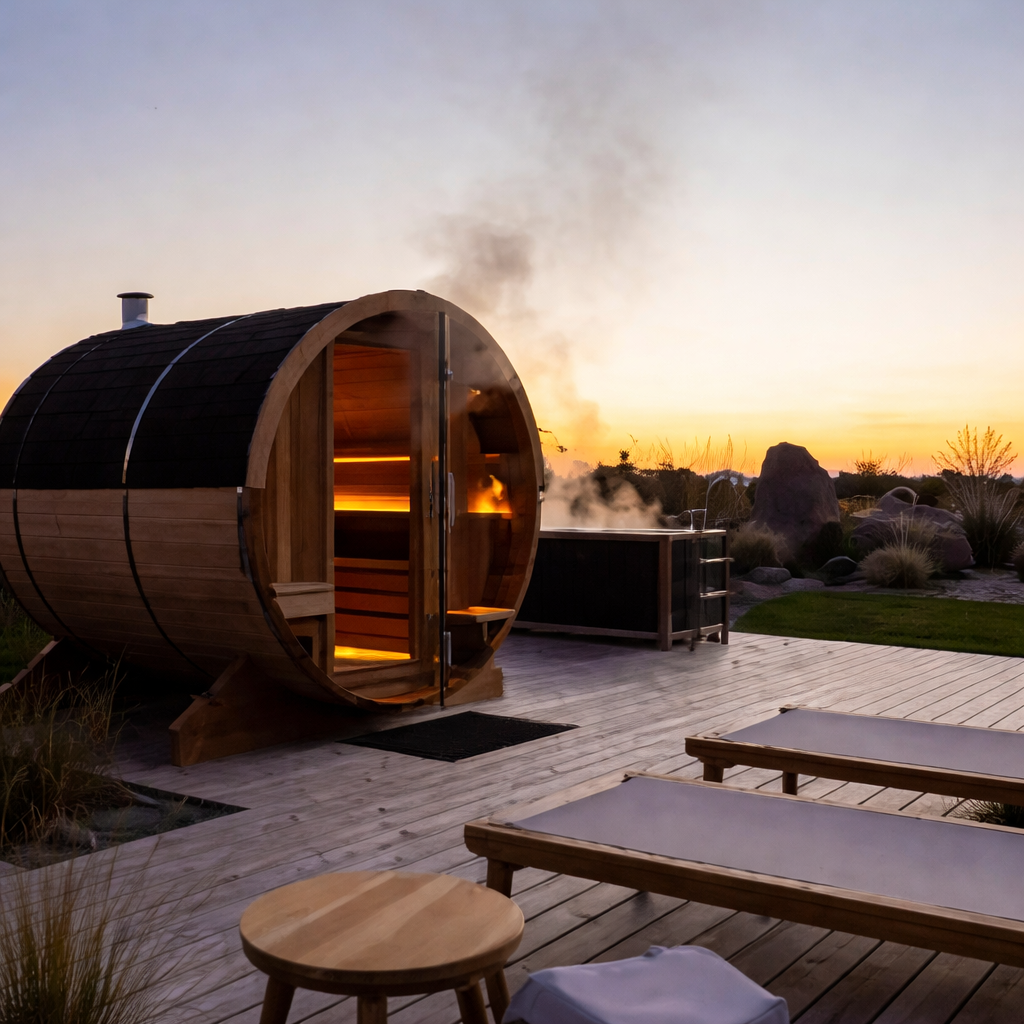
Barrel Sauna
The most accessible outdoor sauna category.
A cylindrical structure in horizontal orientation, the barrel shape promotes efficient heat circulation with no cold corners and often a faster heat-up time than rectangular structures of equivalent volume. Models are commonly available in diameters from 5 to 8 ft (160–240 cm) and lengths from 6½ to 13 ft (200–400 cm).
A barrel sauna can often sit on a compacted gravel pad, railway sleepers, or a timber decking platform — with no concrete foundation required for many models. Barrel saunas are available in both electric and wood-fired heating options.
Typical heat-up times:
- Electric heater: 20–30 minutes
- Wood-fired stove: 30–50 minutes
Best for: First outdoor sauna installation, smaller yards, faster installation timelines, and anyone who wants a traditional aesthetic without a full construction project.
Backyard Cabin Sauna
A traditional rectangular structure built in timber — typically the most space-generous outdoor sauna format.
A cabin sauna can include a dedicated changing room, a covered porch or veranda, and interior dimensions large enough for 4–6 people. The rectangular layout also allows more flexible interior bench arrangements and larger heater configurations for higher temperatures.
A cabin sauna usually requires a solid concrete pad or treated timber frame foundation, plus a dedicated electrical supply run from the main panel.
Typical installation time:
- 1–3 weeks from site preparation to completion, depending on complexity and utility work
Best for: Larger properties, families, those wanting a permanent installation with a changing room, and anyone building a complete outdoor wellness suite.
Pod and Cube Saunas
Architecturally distinctive modern forms — spherical pods, cubic structures, or angular contemporary designs.
This is often the highest-design category in outdoor saunas. These models typically require more bespoke installation and a higher investment, but the visual impact is substantial and they integrate well into contemporary outdoor design.
Best for: Design-forward properties, modern architectural settings, and anyone for whom the visual presence of the sauna is as important as its function.
Wood-Fired vs. Electric Heating
Electric
The most practical choice for most installations.
Electric heaters offer:
- precise temperature control via digital controller
- faster, more predictable heat-up
- no fuel management
Most electric outdoor sauna heaters operate at 240V, 30–60A. A dedicated electrical supply run to the sauna location should be built into your planning from the start.
Wood-Fired
The most traditional option — and often the only heating choice where no electrical supply is required beyond lighting.
Wood-fired stoves produce a distinctive type of heat that many experienced sauna users prefer: slightly softer, more variable, and more atmospheric. They require:
- a firewood supply
- a spark-safe chimney
- more active management of the heating process
Heat-up time is typically longer and less predictable than electric.
For most buyers, electric is the practical starting point. Wood-fired is worth considering for remote locations, off-grid builds, or anyone for whom the ritual of fire-starting is part of the appeal.
Site Selection: The Decisions That Determine Everything
Site selection is the highest-leverage planning decision. Errors here are expensive and difficult to reverse.
Level Ground
All outdoor sauna structures require a level, stable base.
Survey your intended site before proceeding. A slope of more than 2–3° typically requires grading or a raised platform, which should be factored into your foundation budget.
Drainage
Water pooling under a timber structure accelerates deterioration and shortens the structure’s lifespan. Ensure the site drains well, or install a gravel drainage bed beneath the foundation.
This is especially important in climates with heavy rainfall or snowmelt.
Privacy
You will use this space more if it feels private.
Natural screening — existing hedging, fence lines, and strategic planting — is often preferable to constructed screening. Allow 12–18 months after planting for privacy plants to establish fully.
Proximity to the House
Position the sauna close enough to the house that reaching it in bare feet is comfortable in all seasons.
A covered pathway, decked route, or stone path between house and sauna can significantly improve daily usability. If the walk feels like an obstacle, the sauna will be used less.
Morning Sun Orientation
Positioning the sauna entrance or a glazed wall to face east or south can bring morning light into the space. This can improve the cool-down experience and make the space more inviting on colder mornings.
Utility Access
Plan all electrical and water runs before finalizing the site position. Trenching electrical conduit after installation is avoidable and expensive.
Foundation and Electrical: What You Need to Know
Barrel Saunas
Can often sit on:
- compacted gravel (minimum 4 in / 10 cm depth)
- timber sleepers
- decking platforms
The foundation must be level and stable. No concrete is required for many barrel models.
Cabin and Cabin-Style Saunas
Typically require:
- a concrete slab
- or a treated timber frame foundation
A concrete pad for a standard 2-person cabin sauna often costs $600–2,500, depending on size and ground conditions. Allow 7–10 days for concrete to cure fully before positioning the structure.
Electrical Supply
Budget approximately $800–2,500 for a licensed electrician to run a dedicated 240V circuit from your main panel to the sauna location, including:
- trenching
- armored outdoor-rated conduit
- weatherproof subpanel or disconnect
Electrical costs vary significantly by distance from panel to site and by local labor rates, so get quotes early.
Building Permits
Many U.S. municipalities allow accessory structures, including saunas, without a full building permit if they are under a certain size — often:
- under 200 sq ft (18.6 m²)
- under 10 ft (3 m) in height
Electrical work almost always requires a permit and inspection regardless of structure size. Always check local building department and HOA requirements before starting.
Integrating a Cold Plunge
A backyard sauna without an adjacent cold plunge is good. A backyard sauna with one creates a more complete heat-and-cold setup.
Alternating heat and cold is commonly used in routines focused on recovery, relaxation, and overall well-being. The practical key is positioning: the transition from sauna exit to cold plunge entry should ideally take no more than 30 seconds.
Outdoor Cold Plunge Options
A purpose-built outdoor cold plunge with mechanical refrigeration can maintain a precise, programmable temperature year-round — with no ice and minimal preparation.
Most people work within a target range of:
- 50–59°F (10–15°C)
In cooler climates, winter can actually reduce refrigeration load and improve efficiency.
Positioning
Place the cold plunge within 3–5 steps of the sauna exit.
Include:
- a non-slip surface between the two
- optional overhead cover such as a pergola, roof extension, or canopy
This extends comfortable year-round usability in climates with significant rainfall or sun exposure.
Rest Area
The rest phase between rounds matters.
Design a simple outdoor rest space — a lounge chair, daybed, or cushioned bench — positioned between the sauna and cold plunge. This improves the flow of the session and makes the routine easier to sustain.
Design Principles: Making It a Space You Use Every Day
The best-performing outdoor sauna retreats share a set of design principles that go beyond the equipment itself.
Natural Materials Throughout
Thermally modified timber, natural stone, slate, and weathered steel age gracefully outdoors and communicate quality. Materials that improve with time tend to outperform lower-cost synthetic finishes over multiple seasons.
Lighting
Warm, low-level outdoor lighting along the pathway, at the sauna entrance, and in the rest area extends usability into evenings.
Good options include:
- solar-powered pathway lights
- hard-wired warm LED fittings at the sauna and plunge area
Planting for Privacy and Sensory Richness
Fragrant plants adjacent to the rest and cool-down area add a sensory dimension to the space.
Examples:
- lavender
- rosemary
- ornamental grasses
Structural evergreens such as boxwood, yew, and holly provide year-round privacy screening. Allow for mature size when planting.
Towel and Accessory Storage
A weatherproof storage unit adjacent to the sauna for towels, ladles, kindling, and accessories removes friction from the routine.
Small friction points compound into excuses not to use the space.
Connection to the House
A covered walkway or transitional porch connecting the house to the sauna removes one of the most common cold-weather barriers to use.
Even a simple pergola with a weatherproof roof over 10–15 ft (3–4.5 m) of pathway can make a substantial difference.
Protocols: Getting the Most from Your Outdoor Sauna
The outdoor setting offers one protocol advantage unavailable indoors: natural cold air as a cooling medium.
On cooler days, simply stepping outside between rounds can create meaningful temperature contrast, even without a cold plunge.
Standard Session
-
15–20 minutes at target temperature
- Traditional: 170–190°F (77–88°C)
- Infrared: 130–150°F (54–66°C)
- 5–10 minutes outdoors or in a cold plunge
- 10 minutes rest
- Repeat 2–3 rounds
Morning Protocol
Stepping into natural light during the cool-down phase can make the session feel more energizing and help anchor the day’s routine.
Evening Protocol
Many people prefer sauna sessions ending 2–3 hours before bedtime, as part of a wind-down ritual.
Social Sauna
The Finnish tradition treats sauna as a social space — unhurried, conversational, and multi-generational.
A 4–6 person outdoor cabin sauna is one of the most naturally social wellness installations available, and for many people the social dimension is part of what makes the ritual sustainable.
Safety and Maintenance
Safety
All standard sauna safety guidelines apply outdoors:
- no alcohol
- hydrate thoroughly
- exit on any dizziness or discomfort
- seek physician clearance for cardiovascular conditions
Additionally:
- ensure adequate outdoor lighting for safe navigation after dark
- use non-slip surfaces on wet areas
- keep a water source accessible
- store wood-fired kindling away from the structure
Maintenance
- Treat exterior timber annually with a UV-protective, water-repellent finish appropriate for your climate
- Clean interior surfaces monthly
- Lightly sand bench surfaces once per season if needed
- Check electrical connections annually
- Inspect for pest activity in timber structures
- Wood-fired stoves require annual chimney inspection and periodic descaling if used with hard water
|
Start Your Sauna Retreat Solevo infrared saunas are built to perform outdoors and indoors — clinical-grade full-spectrum output, engineered for daily home use, and designed to live beautifully in a considered outdoor environment. |
Scientific References
1. Laukkanen T et al. (2015). Association Between Sauna Bathing and Fatal Cardiovascular and All-Cause Mortality Events. JAMA Internal Medicine https://pubmed.ncbi.nlm.nih.gov/25705824/
2. Laukkanen JA et al. (2018). Sauna bathing is inversely associated with dementia and Alzheimer's disease. Age and Ageing https://pubmed.ncbi.nlm.nih.gov/28938431/
3. Barton J & Pretty J (2010). What is the best dose of nature and green exercise for improving mental health? Environmental Science & Technology https://pubmed.ncbi.nlm.nih.gov/20337470/
4. Kunutsor SK et al. (2024). Sauna bathing and cardiovascular health. Temperature (Austin) https://pmc.ncbi.nlm.nih.gov/articles/PMC10989710/
Disclaimer
|
This content is for educational purposes only and is not intended as medical advice. Always consult a qualified healthcare professional before beginning any wellness or health protocol. |